Researcher, humanist, bioethicist
| Human Longevity + Flourishing
Hi, I’m Raiany.
I’m broadly interested in understanding why secular humans like to narrate death and aging as good things — as if they’d been designed for the good of our species. I’m also interested in quantifying the negative effects of this narrative on economies and people.
I’m the founder of a new 501(c)(3) designed to streamline, inspire, and quantify progress in U.S. science and technology. My goal is to build this think tank into a home for high-agency metascientists, policy entrepeneurs, philosophers, writers and technologists who are committed to building a better future for our species.
My work has been primarily funded by the Amaranth Foundation. Other funders have included the American Federation for Aging Research, the Methuselah Foundation, and one kind anonymous donor. Before this, I helped design and launch the $101 million Healthspan XPRIZE, and was based at the Wyss Institute at Harvard University. Before that, I designed my own Frankenstein of a PhD On the Ethics, Economics, and Science of Human Longevity with George Church, Scott Rivkees, Oded Galor, and Steven Pinker. I am now an Advisor to Fellows and Master’s students in Bioethics at Harvard Medical School.
My book The Good Lifespan: Why and How we Should Redesign Aging is forthcoming with Harvard University Press. I cannot wait to see it in print!
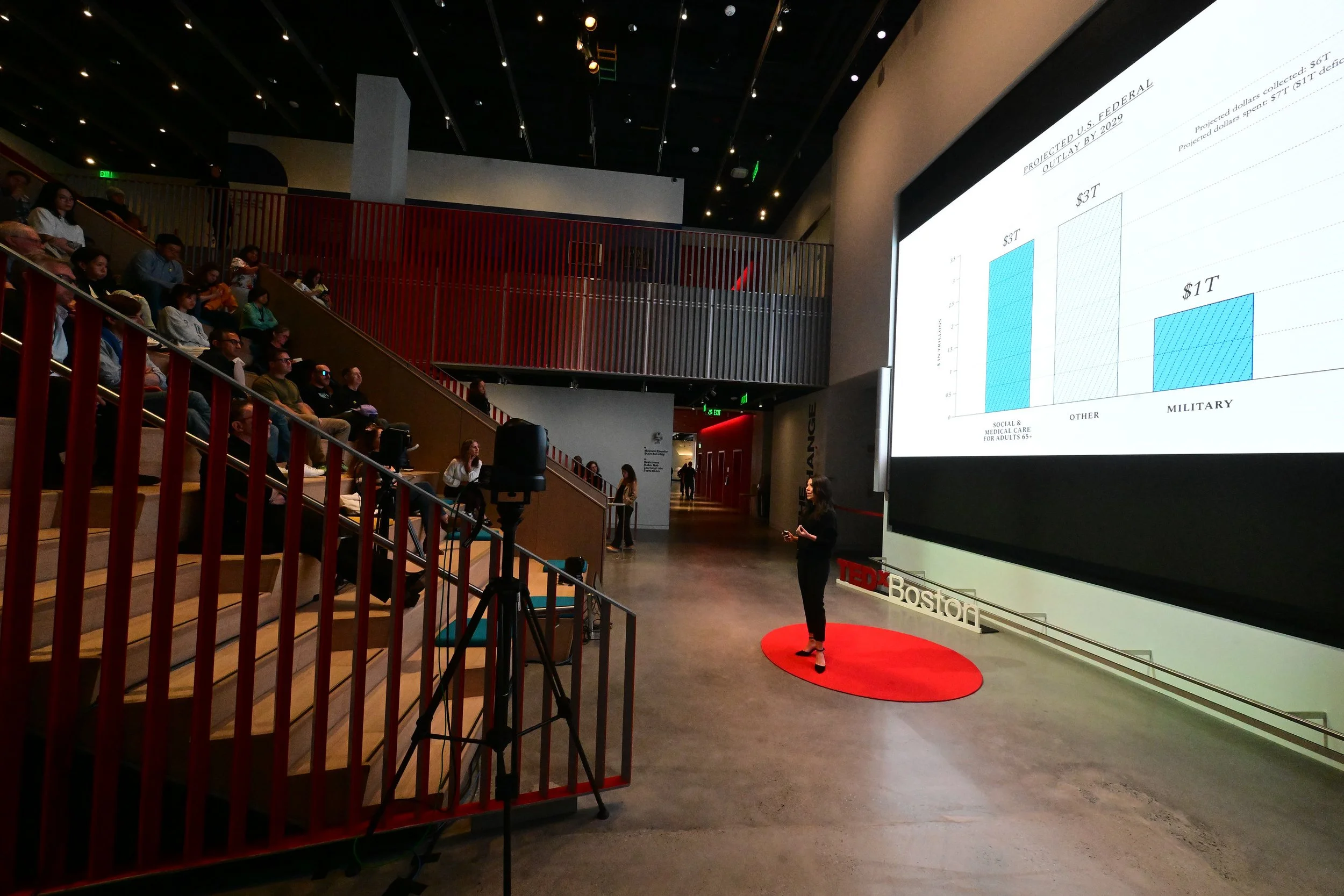
For now, you can click below to play with my new interactive report — including a simulation tool with returns on investment for specific R&D advancements in aging bio. Or you can click the photo above to watch my TEDx talk!
words for ABC:
"If in the Middle Ages the gods were thought to punish human sin with the Black Plague, today we think of poor health in old age as the set-in-scripture decay of the body — a testament to human frailty in the face of a vast and callous universe, the denial of which would result in the sin of arrogance.
We think of aging as the product of this orphic thing called “time,” ignoring that species far less resourceful than ours live on for centuries longer, and some (like the American lobster) do not decrease in strength, do not have their metabolism slowed down, and become more rather than less fertile with the passage of time."
words for Quillette:
“There is hardly a belief more harmful than that biological decay is a mystical, kind, or dialectical force, guiding humanity towards its predetermined and unalterable telos.
It is human agency—with the sweat, faults, and capriciousness of the living—that engenders progress. It is our own ever-ungainly understanding of terms like “disease” and “health” that designs the future of our species.”
words for Bioethics Today:
”Our current institutions, policies, moral frameworks and laws are not fit for 150-year-old humans. But from that, it does not follow that new institutions, policies, and moral frameworks cannot be created. To arrive at the conclusion that we may wish not to treat aging as biology because our current culture or institutions cannot handle it would be as circular as to say, in the 1920’s, that women should not vote, or same-sex marriage should not be legal because we lacked the legal, institutional, or cultural infrastructures for these shifts.
The single most essential form of human innovation may be in healthcare, where lives can be saved and economies vastly improved. Advancements in biotechnology hold the potential to mitigate the effects of pandemics; to lower the disease burden in developed and developing countries; to reduce the suffering associated with grief, hunger, and even age-related poverty. To understand biological aging as a necessary agent of social change is to undermine the agency of living thinkers and doers who have historically been able to solve more problems than their antecedents surmised. Progress and innovation do not magically unfold when funerals—or chronic diseases—take place. They’re most often the result of living, hard-working people.”